Table of Contents
What is Google’s new AI Search?
Google is about to launch its biggest search update in 25 years. The classic 10 blue links per page is being heavily demoted and in its place is a new fully conversational search. It features dynamic and AI-powered responses that support follow-up questions, media inputs (text, images and files) that can monitor the web and even call businesses for you.
Google will also offer digital assistants, known as agents, to automate searches so that someone who may be apartment hunting can be notified of a new listing without opening a real estate site like Zillow.
These new features will be powered by their new Gemini 3.5 Flash model. The company executives claim that the model has improved on creating software code and performing autonomous tasks. Sundar Pichai, Google’s chief executive, said Gemini’s efficiency and lower cost made it easier to roll out on a wider scale, which he believes will ultimately work in Google’s favor.
Here are the new features and functionalities in detail:
Search agents
Google is introducing “Search agents” – AI assistants built directly into Search that can monitor the web for you in the background. Instead of checking for updates yourself, you’ll be able to set up an agent with a specific task or interest, and it’ll continuously scan sources like news sites, blogs, social media, finance data, shopping updates, and sports info.
The idea is to make Search more proactive. For example, you could tell it exactly what kind of apartment you’re looking for, and it would alert you when a matching listing appears. Or if you’re waiting for a sneaker drop from your favorite athlete, the agent can notify you the moment it’s announced.

Google says these AI agents will first roll out this summer for Google AI Pro and Ultra subscribers.
Google is also expanding Search’s AI-powered booking features, making it easier to find and reserve local experiences and services. You’ll be able to describe exactly what you want in plain language, like a private karaoke room for six people on a Friday night with late-night food service, and Search will pull together current pricing, availability, and booking links from different providers.
For some services, including home repair, beauty appointments, and pet care, Google can even contact businesses for you.
On top of that, Google is adding more AI shopping tools to Search, with new agent-style features designed to help users browse and buy products more efficiently. These updates are expected to roll out across the U.S. this summer.
Agentic coding in Search
They’re also turning Search into something closer to an AI-powered workspace. Using its new Antigravity system and Gemini 3.5 Flash, Search will be able to generate custom interfaces in real time instead of only showing standard search results.
That means if you ask a complex question, Search can build interactive visuals, simulations, graphs, tables, or other tools specifically designed around your query. For example, it could create a visual breakdown of an astrophysics concept or an interactive model showing how a mechanical watch works.

Google also wants Search to handle longer-term tasks, not only one-time questions. Users will be able to create personalized dashboards or mini apps for ongoing projects like wedding planning, moving homes, or tracking fitness goals. In one example, Google says Search could generate a custom fitness tracker that pulls in live weather, maps, reviews, and other real-time data to help you stay consistent.
The basic generative UI features are expected to launch for all users this summer, while more advanced “mini app” experiences will first roll out to Google AI Pro and Ultra subscribers in the U.S.
Expanded personal intelligence in Search
They’re also expanding its “Personal Intelligence” features in AI Mode, giving Search more awareness of a user’s personal context. Users in nearly 200 countries and territories will be able to connect apps like Gmail and Google Photos, with Google Calendar support coming later. This will allow Search to provide more personalized and relevant answers.
For example, Search could use information from your emails, photos, or schedule to help with planning, recommendations, reminders, or everyday tasks. Google says these integrations are optional and built around user control, meaning people can decide if and when they want to connect their apps.
The feature is rolling out in 98 languages and won’t require a paid subscription, as Google pushes toward a version of Search that acts more like a personalized AI assistant than a traditional search engine.
Why is Google doubling down on AI?
In short, because investors and Google’s higher ups still believe in the enormous potential of AI (whether that belief is warranted is a topic for another time). Naturally integrating a conversational AI chatbot within their most used and famous product is the logical next step if AI market domination is the end goal.
Ever since OpenAI’s release of ChatGPT in late 2022, Google’s executives and shareholders were wary of the development of AI and how Google could keep up and not be left behind. As it so happens, their biggest fear was that their dominant position in search was going to be in danger. They got to work, and released Gemini on December 6, 2023.
And the fear that Google would be lagging behind a lot in the AI race wasn’t without merit. One of its earliest AI models actually recommended people to use glue to make pizza.
Ever since then, Google has slowly but surely gained on their AI competition. As of 2026, in conversational AI/chatbots, Google Gemini holds roughly 18% to 25% of web traffic share. It’s grown rapidly and cemented itself as the primary competitor to OpenAI’s ChatGPT.
Google AI Overviews were just the first step
Of course, to anyone familiar with how Google has been moving in the past couple of years, this push for a 100% AI search experience will come as no surprise. The writing was on the wall ever since the arrival of AI overviews, which were launched for general users in the US on May 14, 2024 and sporadically in the rest of the world after that.
AI overviews are an aggregator of a user’s search and it gives a quick and easy to digest answer at the top of the page. They were the natural heir to “featured snippets” – quick answers at the top of search results that made it unnecessary to click any link to get the information you wanted. Overviews just took that idea, and instead of one lucky website being quoted, it generates a longer answer based on multiple sources across the web.
Is Google Search just becoming ChatGPT in a different package?
It is going in that direction, however it’s a little more complicated than that. While the classic UI of 10 blue links per page is here to stay, there’s a strong sense of inevitability that one day they might be completely replaced by an AI chatbot interface, that just aggregates website content.
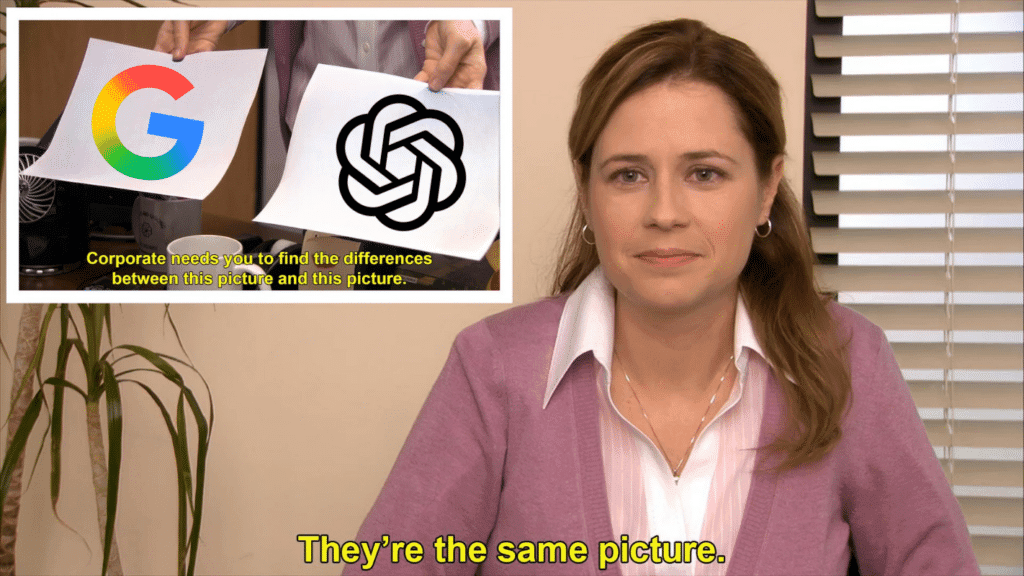
Google can’t just outright abandon that model, since generations of people are so used to it. And while the executives are bragging about Google’s AI numbers and statistics, such as Google AI overviews reaching over 2.5 billion users – the numbers are a bit misleading as a metric to whether people actually want AI in Google Search. The elephant in the room being that you can’t actually turn off AI overviews as a setting. It’s not really 2.5 billion users actively choosing AI overviews, it’s just an integral part of the experience.
Same thing applies to “AI mode”. It’s positioned very strategically to the left of all the other tabs on Google Search (subconsciously asserting to the average user that it’s the default). Throughout the next year,my prediction is that for many users the AI mode will become the default, and it will take a lot of conscious effort to use the traditional tab with 10 blue links (an effort which the average user, a lot of the time, won’t have the will to execute).
What does Google’s new AI Search mean for SEO?
The biggest change is that ranking alone is no longer the end goal.
In AI Mode and AI Overviews, as previously mentioned, Google synthesizes information from multiple sources into a single response. Your content now has to first be selected, then cited, and finally trusted by Google’s AI systems, not only ranked on page one.
This is where concepts like AEO (Answer Engine Optimization) and GEO (Generative Engine Optimization) have gained attention. However, Google itself has made its position clear: optimizing for AI search is still SEO. According to Google’s own guidance, AI search features rely on the same core ranking and quality systems that traditional Search uses.
That means the foundations still matter:
- High-quality, original content
- Strong topical authority
- Clear site structure
- Crawlability and indexability
- Fast, user-friendly pages
What changes is the format and intent behind optimization. AI Search favors content that is easy to interpret, summarize and cite. So that includes pages that directly answer questions, explain concepts clearly and provide unique insights are more likely to appear inside AI-generated responses. One good rule of thumb is “answer first, explain later”. Don’t bury the answer, just have it at the forefront, and give the explanation below.
This also increases the importance of “semantic relevance” over pure keyword targeting. Don’t optimize one page for one exact keyword, you also need to cover broader topic clusters and answer multiple related user intents within the same content ecosystem. AI systems retrieve contextual information, not only exact keyword matches.
Another major concern is traffic. Several early studies suggest that AI-generated summaries can reduce clicks to websites because users often get answers directly on the search page. One recent study found AI Overview exposure reduced traffic to certain informational pages by around 15%, while other reports saw lower click-through rates (CTRs) when AI summaries appeared above organic listings.
At the same time, AI Search could actually create new visibility opportunities. Same research shows that AI systems sometimes cite sources that don’t rank in the top of traditional search results, meaning smaller or more specialized websites still have a chance to gain exposure if their content is valuable and clearly structured.
Where’s it all heading?
Google will never disband the traditional search. It’s simply too ingrained, and a complete removal would invite backlash the likes of which we’ve never seen before. However, I believe that every subsequent update from now on will be pushing the boundary between traditional search and AI mode. More AI features will be integrated to a point where the average user doesn’t even know that there’s a difference between the two.
To AI enthusiasts this is great news. For AI skeptics, it’s another sucker-punch. For SEO professionals it’s more of the same, with some redefinition of KPIs (not panicking at a drop in clicks and and visits is a great start).
FAQ
1. What is Google’s AI Search?
Google’s AI Search is a new search experience powered by generative AI. Instead of only showing a list of links, it can summarize information, answer complex questions, generate visual interfaces, and help users complete tasks directly inside Search.
2. Will AI Search replace traditional Google Search?
Not completely. Traditional search results still exist, but Google is gradually combining them with AI-generated answers and interactive experiences. Search is becoming more conversational and task-oriented.
3. Is SEO still important in the AI Search era?
Yes. Google has repeatedly stated that the same core SEO principles still matter, including high-quality content, expertise, site performance, and relevance. The difference is that content now also needs to be understandable and trustworthy enough for AI systems to reference.
4. Will websites lose traffic because of AI Search?
Potentially, especially for simple informational queries. Users may get answers directly inside Google without clicking a website. However, strong brands and authoritative sites can still gain visibility through citations and mentions in AI-generated responses.
5. What type of content performs best in AI Search?
Content that is clear, well-structured, original, and genuinely useful tends to perform best. AI systems prefer pages that directly answer questions, explain topics thoroughly, and demonstrate expertise.