Table of Contents
What is AI content fatigue?

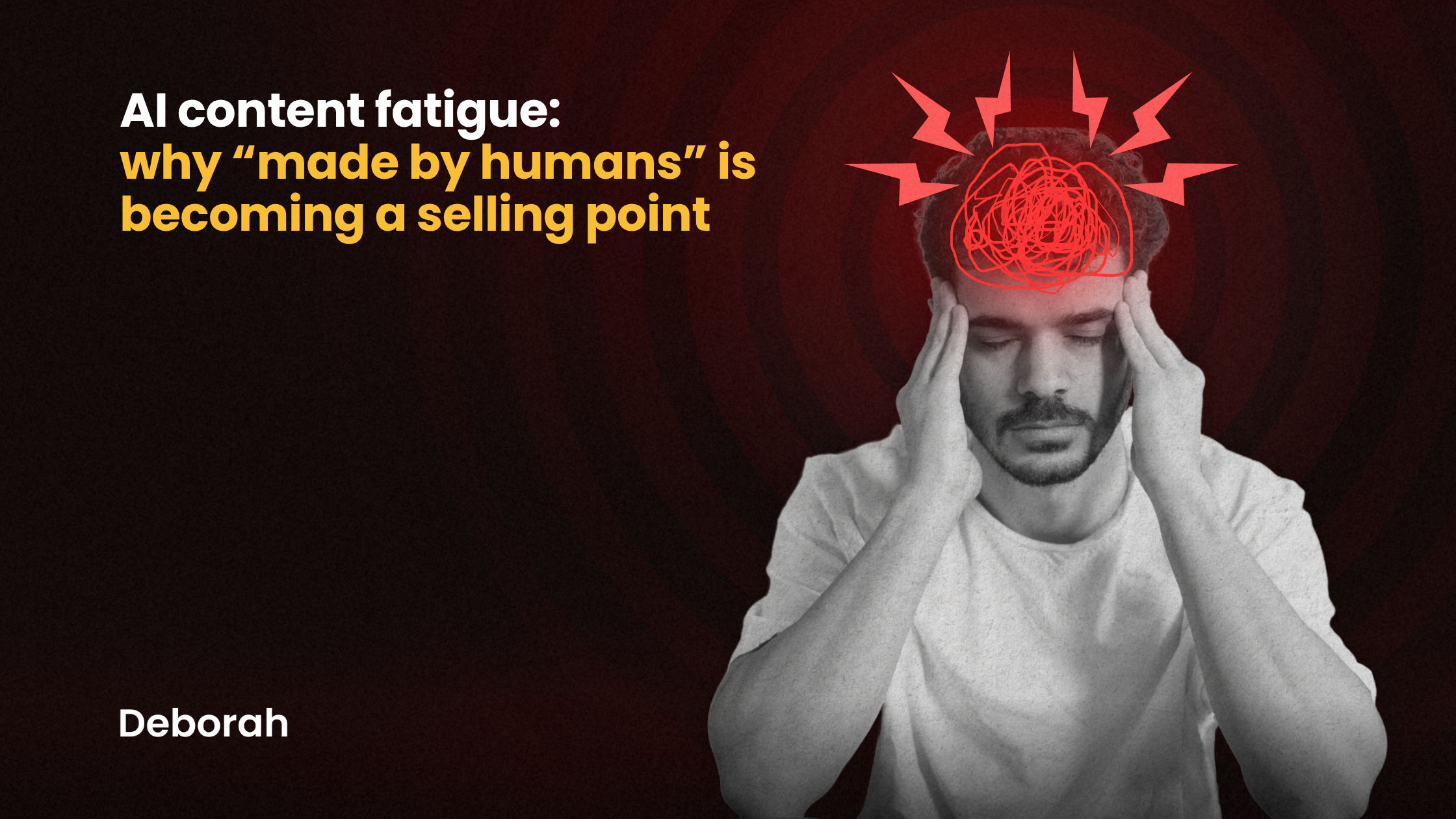
AI content fatigue is the growing sense of boredom or indifference people feel when they see huge amounts of similar, machine-assisted content. It’s not a clinical term, and there is no precise point at which ordinary content becomes exhausting. You usually notice it when another polished post appears and you feel as though you’ve read it, even when you haven’t.
The signs are becoming familiar. There are dramatic opening questions, perfectly balanced paragraphs, predictable summaries and visuals that look impressive until you try to remember anything about them. Videos have the same synthetic narration. LinkedIn posts arrive with the same rhythm, the same pauses and the same carefully arranged lesson at the end (which in many cases ends up with the “buy our xy product” sales pitch).
None of these features proves that AI was used. A human can write generic content without assistance, while someone using AI can still produce something thoughtful and original. The fatigue comes from repeatedly seeing the same patterns, regardless of how they were made.
LinkedIn uses the term “AI slop” to describe low-effort content that may appear polished but lacks substance or a distinct point of view. That last part matters. Audiences are rarely annoyed because a tool saved someone time. They lose interest when the final result gives them nothing specific, surprising or useful.
AI content fatigue is also paradoxically quiet. People don’t usually stop to complain about a forgettable post. They scroll past it, skip the video or leave the page. A brand can therefore publish more content than ever, receive little visible criticism and still become increasingly easy to ignore.
That is what makes the problem difficult to measure. The clearest sign may be an absence of reaction. The content works technically, appears regularly and says all the correct things. It simply leaves no reason to remember who published it.
How content became an abundance problem
Generative AI saved a lot of time and cost involved in producing an acceptable post, image or video. A first draft can now be done in seconds, and one idea can quickly become ten variations. But the amount of attention available didn’t expand with it.
This creates a problem: more content is competing for the same limited number of views, clicks and minutes. Every post becomes easier to replace and easier to ignore. Publishing more can increase a brand’s chances of appearing in the feed, while also making the feed less interesting overall.
We have already discussed why producing more content is no longer enough. AI makes that argument even more potent. The bottleneck (the part of the process that limits everything else) has moved from production to judgement. Brands can create almost anything quickly. The valuable skill is deciding what deserves to be created at all.
Platforms now have a quality problem
When people complain about repetitive AI content, platforms have a reason to listen. Their business depends on users continuing to scroll and watch. A feed filled with interchangeable posts may be cheap to produce, but it is not really enjoyable to use.
YouTube now places mass-produced, generic and repetitive videos under its “inauthentic content” monetisation policy. AI-assisted videos can still earn money when they contain original ideas, commentary or creative value. The issue is when every upload feels like another version of the same template.
Surprisingly, LinkedIn is taking a similar approach. The platform says generic content identified as likely AI-generated is less likely to be distributed beyond the author’s immediate network, particularly when it lacks perspective, context or expertise (think any number of LinkedIn posts you’ve seen over the years from people you never heard of).
Pinterest has responded more directly by introducing labels and controls that let users reduce the amount of generative AI imagery in parts of their feed.
Taken together, these changes suggest that platforms are mainly concerned with the experience created by AI content. The recurring target is material produced at scale without adding much substance.
For brands, that makes mass production not really an advantage. Filling a content calendar faster will also fill it with posts that platforms have little reason to distribute or recommend on their feeds. The useful question is now simple: why would anyone need this particular post?
Why “Made by Humans” is becoming more valuable
One recent Reddit comment captured the mood rather bluntly: “I’d pay more for a hand-drawn stick figure at this point.”
That is one person venting on online forums, so it shouldn’t be treated as market research. It does, however, sound quite close to what some broader studies are beginning to find.
In a June 2026 survey of 1,017 US adults, 68% chose a product labelled “made by humans” over an identical AI-made product at the same price. And even more interesting, 54% said they would pay extra for the human-made option. Most selected a modest premium of 5% or 10%, although 1 in 5 claimed they would pay at least 25% more.
Claimed willingness to pay should always be treated carefully. People are generous with imaginary money, especially when a question allows them to express their values. On the other side of the coin, there’s also evidence involving real buying decisions.
A 2026 Creative Industries Policy and Evidence Centre experiment asked participants to bid for physical art prints and mugs featuring short poems. The researchers had already tested the human and AI work to make sure it had similar appeal and that people couldn’t reliably identify its origin. Once the origin was disclosed, the broader UK sample placed higher bids on the human-made items.
There was a complication though. The premium came mainly from participants aged 35 and over. Among people aged 18 to 34, the researchers found no difference. “Made by humans” clearly has value for some buyers (especially in the older age range), but it is far from a universal guarantee.
So what are people paying for when the finished result can look almost identical?
With creative work, the process is part of the product. People respond to the idea that someone made choices, developed a skill, revised the work and could have failed along the way. The final product, whatever that may be, carries evidence of another person’s time and intention. Remove that person and the output can still look good, but not have any value in many people’s eyes.
This helps explain why participants in a Columbia Business School study valued artwork labelled as AI-generated 62% lower than work labelled as human-made. Interestingly, the human premium appeared when human and AI work were shown together. Human authorship became more valuable once there was something to contrast it with.
That may be the real shift in thinking. We used to assume human involvement, so brands rarely needed to mention it. Now it can become part of the story, much like “handmade,” “locally produced” or “independently owned.” A named writer, an illustrator’s sketches, a behind-the-scenes video or a visible editing process shows where the product came from.
A label alone will eventually become easy to copy. The better advantage comes from making the human contribution visible.
The human premium exists, though it’s uneven and still developing. It’s going to be strongest when audiences can see the effort, intention and point of view behind the finished work. “Made by humans” is great when the humans involved have clearly added something worth paying for.
What brands should do differently?

AI can help with research, early drafts, transcription, variations and repetitive production tasks. The finished content should still pass through someone who understands the audience, checks the claims and has a reason for publishing it.
The easiest way to prove that a human was involved is to leave evidence of human judgement. Use customer questions, project experience, local knowledge and opinions that can’t be produced from a generic prompt. Show sketches, rejected ideas, behind-the-scenes footage or the decisions that shaped the final result.
Credit also matters. Naming the writer, designer, photographer or strategist gives the work a visible source and someone willing to stand behind it.
Finally, publish less when there is nothing useful to add. A quiet week is unlikely to damage a brand. A steady stream of forgettable content can gradually teach people to ignore it.
FAQ
1. What is AI content fatigue?
AI content fatigue is the boredom or indifference people feel after seeing too much generic, repetitive or predictable AI-assisted content.
2. What does “AI slop” mean?
“AI slop” is an informal term for low-effort AI content produced in large quantities. It may look polished, but usually offers little useful information or original thought.
3. Do social platforms penalise AI-generated content?
Usually, the use of AI alone is not the problem. Platforms are more likely to limit, demonetise or remove content that is repetitive, misleading, spam-like or mass-produced without adding meaningful value.
4. Should brands stop using AI to create content?
No. AI can save time during research, drafting and production. Brands should still use human judgement to check facts, add context and decide whether the content is worth publishing.
5. How can brands make AI-assisted content feel more human?
Add specific experiences, real examples and clear opinions. Careful editing, visible creator credits and glimpses of the creative process can also show that a person shaped the finished work.